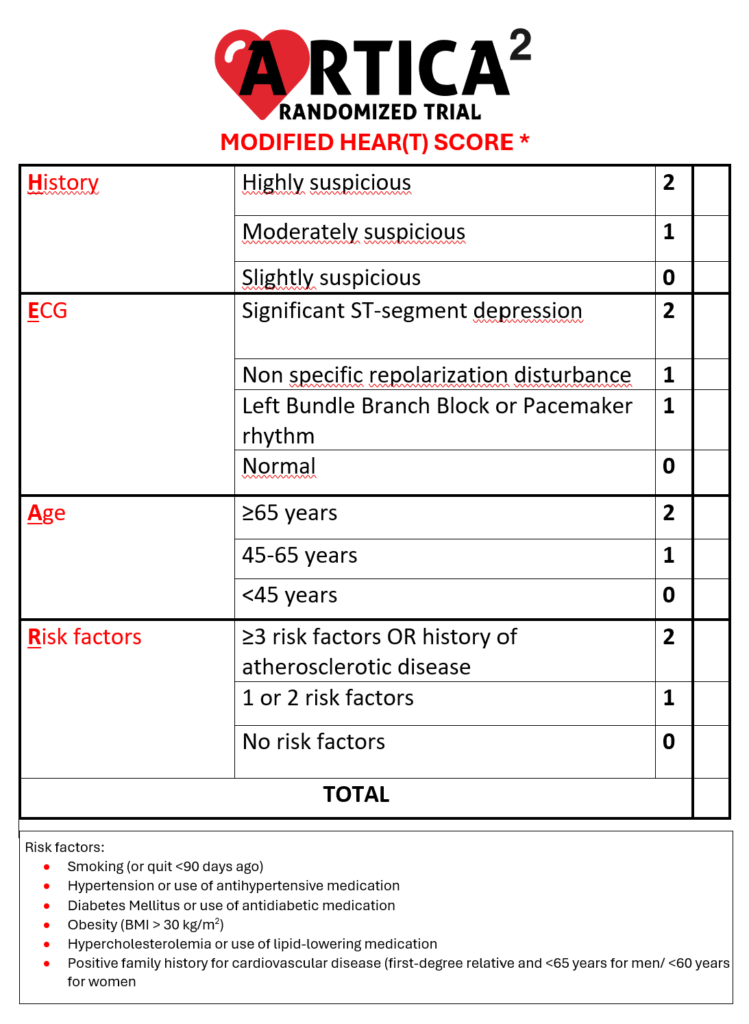
The HEART Score consists of 5 elements: History, ECG, Age, Risk factors and Troponin. Each element is assigned 0 to 2 points, meaning that a patient can receive a total score ranging from 0 to 10 points. For more information about the original HEART score, see: heartscore.nl
In the ARTICA trials, we use the modified HEAR(T) score, in which troponin is separated from the HEART score. This means that only the first four variables, HEAR, are considered.
Previous research has shown that patients with a modified HEAR(T) score ≤3 and a low troponin level can safely remain at home. The remaining population, patients with a modified HEAR(T) score ≥4, are currently routinely transported to the nearest hospital. We are going to investigate this method of care.
If the modified HEAR(T) score is ≥4, we consider the patient to have an intermediate or high risk of acute coronary syndrome and the patient is eligible for the ARTICA-2 trial. After inclusion, the patient is randomised into one of two groups. In both groups, a point-of-care high-sensitivity troponin measurement is performed. This is a rapid test that provides a result after 15 minutes. We use sex-specific cut-off values: <13 ng/L is considered normal for women and <28 ng/L for men.
In the standard care group, the patient will be transported to the (Cardiac) Emergency Department of the nearest hospital, regardless of the troponin result. In the intervention group, the risk of acute coronary syndrome is determined based on the modified HEAR(T) score in combination with the result of the troponin measurement. Further management is then determined based on this risk. With this study, we aim to investigate whether this strategy brings patients directly to the appropriate place.